Last Updated on 19 November 2026 by Sandesh Hiwale
BUDDHISM • SOCIAL REVOLUTION • HISTORY
22 Vows of Dr. Ambedkar
Direction of Social Revolution
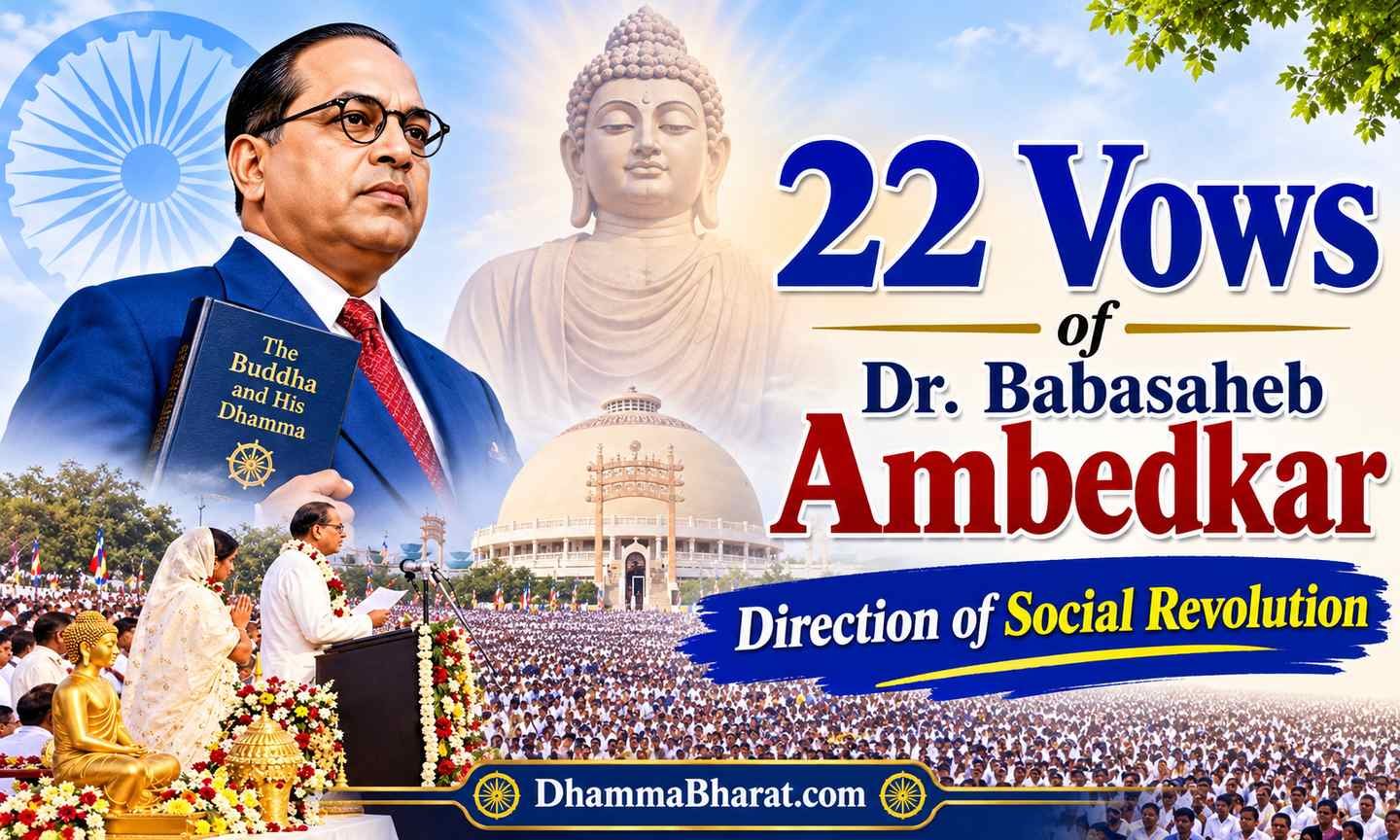
The historic twenty-two vows administered by Dr. Babasaheb Ambedkar during the Buddhist conversion ceremony at Deekshabhoomi, Nagpur, on 14 October 1956.
Historic Date
14 October
1956
Historic Location
Deeksha Bhoomi
Nagpur, Maharashtra
The Historic Pledges
22
Buddhist Vows
IN THIS ARTICLE
01 / HISTORICAL BACKGROUND
The Historic Buddhist Conversion at Deekshabhoomi
On 14 October 1956, Dr. Babasaheb Ambedkar, along with approximately five lakh followers, publicly renounced Hinduism and embraced Buddhism at Deekshabhoomi in Nagpur, Maharashtra. During this historic conversion ceremony, Dr. Ambedkar administered twenty-two vows to his followers.
These 22 Vows of Ambedkar were formulated by Babasaheb himself to establish a clear distinction between Buddhist principles and the religious practices and beliefs he was renouncing. They represent a commitment to equality, liberty, fraternity, compassion, rational thinking and human dignity.
The 22 vows are not merely religious pledges; they also represent a direction for social transformation and a new way of life based on the teachings of the Buddha.
THE SIGNIFICANCE OF 14 OCTOBER 1956
A historic beginning of a new religious and social identity.
The conversion ceremony at Deekshabhoomi became an important milestone in the history of modern Indian Buddhism and the Ambedkarite movement.
02 / THE HISTORIC PLEDGES
22 Vows of Dr. Ambedkar
The 22 Buddhist vows were administered by Dr. Babasaheb Ambedkar to his followers on 14 October 1956 at Deekshabhoomi, Nagpur, when they renounced Hinduism and embraced Buddhism.
He formulated these pledges to completely break away from the religious beliefs, customs and practices of his former religion, which he considered incompatible with the principles of equality and human dignity.
Through these vows, Babasaheb encouraged his followers to adopt Buddhist teachings and build a society based on equality, morality, compassion and fraternity.
03 / COMPLETE LIST
22 Buddhist Vows by Dr. B. R. Ambedkar
Below are the 22 Vows of Dr. Babasaheb Ambedkar in English:
01–08 / RENUNCIATION OF FORMER BELIEFS
The first eight vows express the renunciation of former religious beliefs, worship practices and rituals.
I shall have no faith in Brahma, Vishnu and Shiva, nor shall I worship them.
I shall have no faith in Rama and Krishna, who are believed to be incarnation of God, nor shall I worship them.
I shall have no faith in Parvati, Ganesh and other gods and goddesses of Hindus, nor shall I worship them.
I do not believe in the incarnation of God.
I do not and shall not believe that Lord Buddha was the incarnation of Vishnu. I believe this to be sheer madness and false propaganda.
I shall not perform Shraddha nor shall I give pind.
I shall not act in a manner violating the principles and teachings of the Buddha.
I shall not allow any ceremonies to be performed by Brahmins.
09–10 / EQUALITY AND SOCIAL JUSTICE
These vows emphasise equality among human beings and the responsibility to establish equality in society.
I shall believe in equality of human beings.
I shall endeavour to establish equality.
11–12 / TEACHINGS OF THE BUDDHA
These vows encourage the practice of the Noble Eightfold Path and the ten Paramitas.
I shall follow the Noble Eightfold Path of the Buddha.
I shall follow the ten paramitas prescribed by the Buddha.
13–17 / COMPASSION AND MORAL CONDUCT
These five vows are associated with ethical conduct and the Five Precepts of Buddhism.
I shall have compassion and loving-kindness for all living beings and protect them.
I shall not steal.
I shall not tell lies.
I shall not commit carnal sins.
I shall not take intoxicants like liquor, drugs, etc.
Note: The previous five proscriptive vows [#13-17] are from the Five Precepts.
18–22 / ADOPTION OF BUDDHISM AND NEW WAY OF LIFE
The final vows express the commitment to Buddhism and the determination to live according to the Buddha’s Dhamma.
I shall endeavour to follow the Noble Eightfold Path and practice compassion and loving-kindness in everyday life.
I renounce Hinduism, which disfavors humanity and impedes the advancement and development of humanity because it is based on inequality, and adopt Buddhism as my religion.
I firmly believe the Dhamma of the Buddha is the only true religion.
I believe that by adopting Buddhism I am having a re-birth.
I solemnly declare and affirm that I shall hereafter lead my life according to the teachings of Buddha’s Dhamma.
THE CENTRAL MESSAGE
Equality • Morality • Compassion • Fraternity
A commitment to a life guided by the Buddha’s Dhamma.
04 / HISTORICAL AND SOCIAL SIGNIFICANCE
Importance of the 22 Vows of Ambedkar
The 22 Vows of Ambedkar hold great historical, religious and social significance. These vows were formulated to guide people who embraced Buddhism towards a life based on the Buddha’s teachings.
Their importance can be understood through the following points.
01. Renunciation of the Old Religious Beliefs
The first eight vows explain the beliefs and religious practices that Babasaheb wanted his followers to renounce. They reject the worship of Hindu gods and goddesses, the concept of divine incarnations, Shraddha rituals and ceremonies performed by Brahmins.
These vows establish a clear separation from the religious beliefs and customs of the former religion.
02. Equality and Social Justice
The ninth and tenth vows emphasise equality among all human beings and the responsibility to work towards establishing equality in society.
Dr. Ambedkar believed that social equality was essential for a just and progressive society. These vows encourage people to reject discrimination and work towards building a society based on equal human dignity.
03. Following the Teachings of the Buddha
The eleventh and twelfth vows encourage followers to practise the Noble Eightfold Path and the Paramitas prescribed by the Buddha.
The Noble Eightfold Path provides guidance for right understanding, right thought, right speech, right action, right livelihood, right effort, right mindfulness and right concentration.
The Paramitas represent qualities and practices that help individuals develop morally and spiritually.
04. Compassion, Morality and Ethical Conduct
The thirteenth to seventeenth vows emphasise compassion, loving-kindness, protection of living beings, honesty, respect for others and abstinence from intoxicants.
These principles are closely connected with the Five Precepts (Panchasheel) of Buddhism.
05. Adoption of Buddhism and a New Way of Life
The final vows express a complete commitment to Buddhism. They encourage followers to renounce the former religious identity based on inequality and adopt the Buddha’s Dhamma.
The twenty-second vow is particularly significant because it declares the commitment to lead one’s entire life according to the principles and teachings of the Buddha.
05 / FREQUENTLY ASKED QUESTION
Are the 22 Vows Mandatory to Become a Buddhist?
A common question arises whether every person who renounces Hinduism and embraces Buddhism must take the 22 Vows of Dr. Babasaheb Ambedkar. To understand this question, it is important to consider the religious, historical and social significance of these vows.
Dr. Babasaheb Ambedkar was not merely a social reformer, scholar or political leader. For the Ambedkarite Buddhist community, he is also a great spiritual leader and a Bodhisattva. Therefore, his thoughts, teachings and the 22 Vows hold a special place in the religious and spiritual lives of Ambedkarite Buddhists.
The 22 Vows are an integral part of the Ambedkarite Buddhist conversion tradition. Through these vows, Babasaheb encouraged his followers to renounce their former religious beliefs, rituals and practices based on inequality, and to lead their lives according to the teachings of the Buddha.
Religious Tradition and Legal Requirements
However, it is important to distinguish between religious traditions and legal requirements. In India, there is no general statutory provision requiring every person who converts to Buddhism to take all 22 Vows in order to be legally recognised as a Buddhist.
Nevertheless, these vows hold great religious and ideological significance in the Ambedkarite Buddhist tradition. They are not merely a formal ritual but represent a commitment to renouncing former religious beliefs and following the Buddha’s Dhamma. Therefore, according to the Ambedkarite tradition, a person embracing Buddhism is expected to undertake the 22 Vows along with Trisharan (Three Refuges) and Panchasheel (Five Precepts).
In the Ambedkarite Buddhist tradition, these vows are widely respected and practised as an important declaration of renunciation of the former religious beliefs and commitment to the Buddha’s Dhamma.
In particular, people associated with the Ambedkarite movement and community groups recite these 22 Vows during Buddhist conversion ceremonies and express their commitment to practising them in their daily lives.
06 / HISTORICAL DOCUMENT
Dr. Babasaheb Ambedkar’s Original Handwritten Marathi Vows
The below photograph is particularly significant because it contains the original handwritten Marathi document of Dr. Babasaheb Ambedkar.
In this document, Babasaheb personally wrote the first three vows under the heading ‘पूर्वाश्रमीच्या धर्माची त्याग प्रतिज्ञा’. His signature and date are also visible below the text.
These handwritten pledges provide an important historical reference to Babasaheb’s own formulation of the vows.
ORIGINAL HISTORICAL DOCUMENT
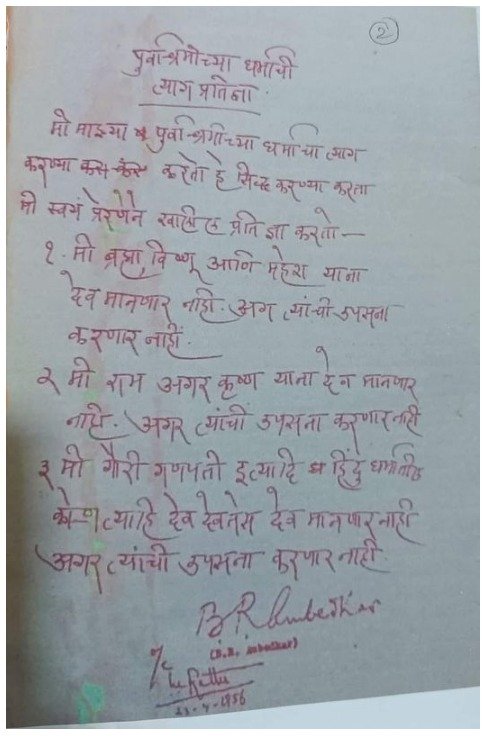
Original handwritten Marathi document of Dr. Babasaheb Ambedkar containing the first three vows under the heading ‘पूर्वाश्रमीच्या धर्माची त्याग प्रतिज्ञा’. His signature and date are also recorded below the handwritten text.
A Historical Reference
Babasaheb’s handwritten document is an important historical piece that illustrates his intention to formally renounce his former religious beliefs and adopt Buddhism.
07 / ORIGINAL MARATHI TEXT
पूर्वाश्रमीच्या धर्माची त्याग प्रतिज्ञा
Pledge of Renunciation of the Former Religion
मी माझ्या पूर्वाश्रमीच्या धर्माचा त्याग करतो हे सिद्ध करण्याकरता मी स्वयंप्रेरणेने खालील प्रतिज्ञा करतो.
To establish that I renounce my former religion, I voluntarily make the following vows of my own accord.
मी ब्रह्मा, विष्णू आणि महेश यांना देव मानणार नाही. अगर त्यांची उपासना करणार नाही.
I shall not regard Brahma, Vishnu and Mahesh as gods, nor shall I worship them.
मी राम अगर कृष्ण यांना देव मानणार नाही. अगर त्यांची उपासना करणार नाही.
I shall not regard Rama or Krishna as gods, nor shall I worship them.
मी गौरी गणपती इत्यादी हिंदू धर्मातील कोणत्याही देव देवतेस देव मानणार नाही अगर त्यांची उपासना करणार नाही.
I shall not regard Gauri, Ganapati or any other gods and goddesses of Hinduism as deities, nor shall I worship them.
08 / CONCLUSION
22 Vows: A Direction for Social Revolution
The 22 Vows of Ambedkar represent an important milestone in the history of modern Indian Buddhism and the social revolution initiated by Dr. Babasaheb Ambedkar.
These vows go beyond religious conversion. They provide a framework for developing a society based on equality, liberty, fraternity, compassion, morality and human dignity.
By embracing Buddhism and administering these twenty-two vows to his followers, Babasaheb gave millions of people a new religious identity and a path towards social and spiritual transformation.
Even today, the 22 vows continue to inspire followers of Dr. Babasaheb Ambedkar and people who believe in the Buddha’s teachings.
THE LEGACY OF DR. B. R. AMBEDKAR
Equality • Liberty • Fraternity
A new way of life guided by the teachings of the Buddha and the values of human dignity.
14 October 1956
Deekshabhoomi, Nagpur, Maharashtra
ARTICLE PUBLICATION DETAILS
BUDDHA • DHAMMA • AMBEDKAR
Understand the 22 Vows. Understand the Social Revolution.
Explore the teachings of the Buddha, the thoughts of Dr. Babasaheb Ambedkar and the historical journey of the Ambedkarite Buddhist movement.